
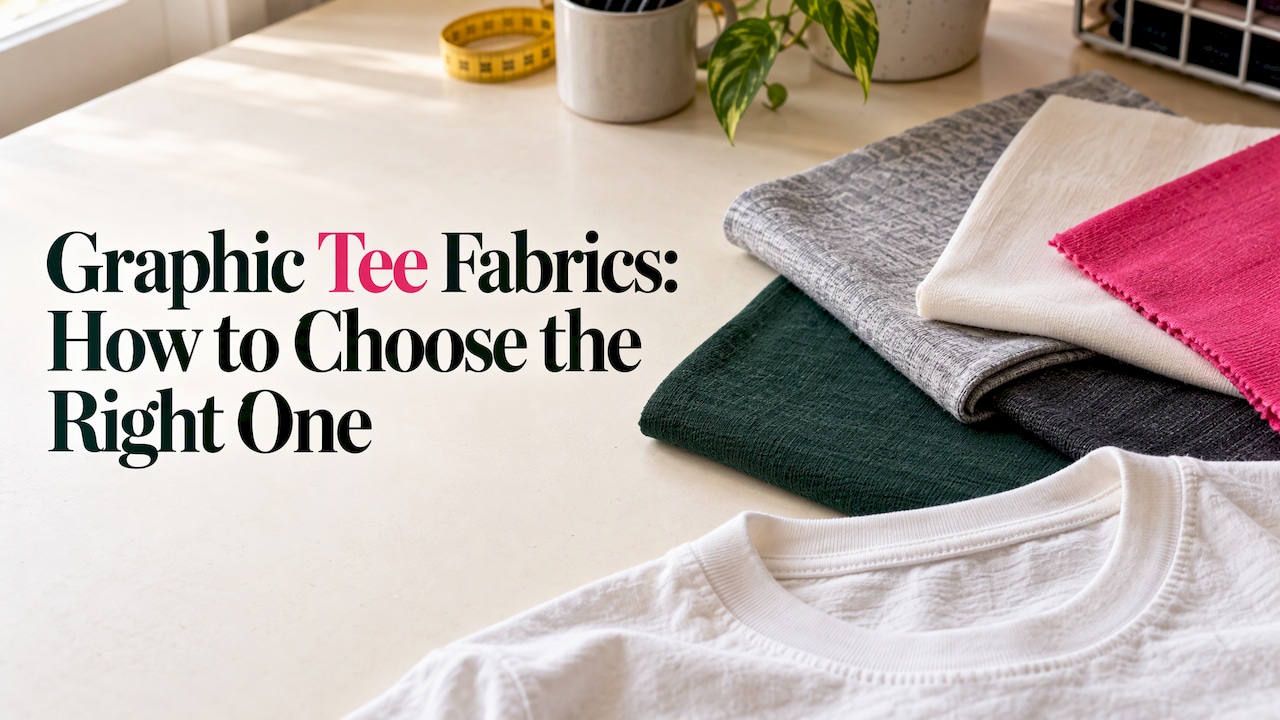
The best fabric for a graphic tee is the one that matches how you will wear it. Cotton is the classic pick for softness and breathability. A cotton-polyester blend is the pick for a shirt that holds its shape and shrinks less. A tri-blend is the pick for a drapey, vintage feel. Weight matters as much as fiber, so read the label and the gram weight, not just the marketing word on the hang tag.
This guide walks through every common t-shirt fabric, what each does to a printed design, how to read a label in the store or online, and how to match fabric to the way you live in your tees.
TL;DR
- 100% cotton is soft, breathable and a safe default for printed designs, but it can shrink and wrinkle more than blends.
- Cotton-polyester blends trade a little softness for stability: less shrinking, fewer wrinkles and faster drying.
- Tri-blends (cotton, polyester and rayon) feel light and drapey, with a lived-in look from day one.
- Fabric weight in GSM tells you more about quality than the fiber name. Midweight tees of roughly 160 to 200 GSM suit most people.
- The fiber content on the garment label is the most dependable way to know what you are buying.
Table of Contents
- The fabrics behind most graphic tees
- Fabric comparison at a glance
- Why weight matters as much as fiber
- Construction details that signal a better tee
- How fabric affects a printed design
- How to identify what a tee is made of
- Matching fabric to how you live
- Caring for graphic tees so they last
- Common mistakes when buying a graphic tee
- Perspective
- Find your next witty tee
- FAQ
- Sources
The fabrics behind most graphic tees
Almost every graphic tee you will meet is made from one of five fabric families. Knowing the differences takes a minute and saves you from a shirt that feels wrong after the first wash.
100% cotton
Cotton is a natural fiber and the default for printed tees. It breathes well, feels familiar against the skin and tends to give a printed design a clean, solid look. Its weak spots are predictable: it can shrink in a hot wash and dryer, and it creases more easily than a blend.
Not all cotton tees are equal, though. You will see terms like ringspun, combed and carded. Ringspun cotton is spun to give a smoother, finer yarn, which is why a ringspun tee often feels softer than a basic one at the same weight. The fashion editors at The Fashionisto point to a 180 GSM ringspun cotton tee as having enough body to hold its shape and hang cleanly.

Polyester
Polyester is a synthetic fiber. It resists wrinkles, dries fast and keeps its size, which is why it shows up in athletic shirts. It generally feels less like a classic tee and can feel warmer in humid weather, because it does not breathe the way cotton does. If you want a shirt for the gym or a long hike, polyester earns its place. For a lazy Sunday and a favorite one-liner across the chest, most people reach for something softer.
Cotton-polyester blends
Blends try to give you the best of both. According to a textile industry guide to cotton, polyester and blends, a cotton-poly blend balances cotton’s comfort with polyester’s dimensional stability, wrinkle resistance and faster drying. The same guide notes that a 50/50 blend offers more stability and less shrinkage than pure cotton.
In practice, blends are the “set it and forget it” tees. They come out of the dryer looking better, and they tend to stay the size you bought. The trade-off is feel: the more polyester in the mix, the less it behaves like a pure cotton shirt.

Tri-blends
A tri-blend combines cotton, polyester and rayon. The result is a thin, fluid fabric with a soft hand and a slightly heathered look. Tri-blends drape instead of standing away from the body, so they are popular for fitted, vintage-style tees. Because they are lighter, they feel less sturdy than a thick cotton tee. If you want a tee that feels broken in the moment you put it on, this is the family to try.
Specialty fibers: bamboo, modal and organic cotton
You will also see tees marketed as bamboo, modal or organic cotton. Bamboo and modal are typically processed into soft, smooth, rayon-like fabrics with a cool, fluid feel. Organic cotton is still cotton, so it behaves like cotton, with the difference being how the crop was grown. These are worth a look if you have a specific preference, but for most graphic tee wearers the decision comes down to cotton, a blend or a tri-blend.
Fabric comparison at a glance
Use this table as a quick reference. These are general tendencies, not guarantees: weight, knit and finishing change how any one shirt behaves.
| Fabric | Feel | Breathability | Stretch and shape | Shrink and wrinkle risk | Best for |
|---|---|---|---|---|---|
| 100% cotton | Soft, classic | High | Moderate | Higher | Everyday wear, warm weather |
| Polyester | Smooth, slick | Lower | Holds shape well | Low | Active use, quick drying |
| Cotton-poly blend | Soft, slightly smoother | Medium to high | Holds shape well | Lower | Frequent washing, travel |
| Tri-blend | Very soft, drapey | Medium | Flowing, fitted | Low to moderate | Vintage look, casual layering |
| Bamboo or modal | Silky, cool | High | Fluid | Varies | Sensitive-feeling, lightweight tees |
Why weight matters as much as fiber
Two shirts that are both “100% cotton” can feel completely different. The reason is weight, usually measured in GSM, or grams per square meter. A higher GSM means more fabric per square meter: a heavier, sturdier tee. A lower GSM gives you a lighter, thinner one.
The Fashionisto’s guide recommends aiming for a midweight tee of 160 to 200 GSM when quality is your goal. That range is a useful rule of thumb:
- Lightweight (under about 160 GSM): airy and good for heat, but can look see-through in light colors and may wear out sooner.
- Midweight (about 160 to 200 GSM): the sweet spot for most graphic tees. It has body, drapes well and survives regular laundering.
- Heavyweight (above about 200 GSM): structured and boxy, with a substantial feel. It can run warm in summer.
GSM is not always listed on a product page. When it is missing, use other cues: how the fabric hangs on the model, how the product description talks about weight, and whether the shirt is called lightweight, classic or heavy.
Construction details that signal a better tee
Fabric is only half the story. The same guide suggests checking for double-needle stitching at the hems and tape reinforcing the collar seam. Both details help a shirt keep its shape. A collar that goes wavy after a few washes is one of the most common reasons a favorite graphic tee ends up in the back of the drawer.
Two more things to watch for:
- Side seams. Some tees are knit in a tube with no side seams, and others are cut and sewn. Neither is wrong, but the cut-and-sew style often fits more precisely.
- Neckline. A ribbed crew neck that springs back when you stretch it is a good sign.
How fabric affects a printed design
A graphic tee exists to carry a design, so the fabric under the ink matters. In general, cotton and cotton-rich fabrics take most common apparel printing methods well and tend to give clean, saturated color. Polyester and polyester-heavy fabrics suit certain methods, such as sublimation, better than others. A recent overview of t-shirt fabric choices says much the same: cotton usually prints the most vibrant designs, while polyester and blends may suit specific printing methods.
What that means for you as a shopper:
- Smooth, tightly knit fabric shows fine details, small text and one-liners more crisply than a heavily textured fabric.
- Light-colored shirts show the design’s colors as intended, while dark shirts rely on the way the design was prepared for them.
- Heathered and tri-blend fabrics give a softer, slightly faded look to a print. That can be exactly what you want for a retro design, and less ideal for a bold, high-contrast one.
If you love a particular quote or joke, think about whether you want it to look crisp and loud or soft and worn. That is partly a fabric decision.
How to identify what a tee is made of
Marketing words like “premium,” “super soft” and “buttery” are not fabric information. Here is how to find the real answer.
- Read the garment label. In the United States, clothing labels list fiber content by generic name, in order of weight. A label that reads 60% cotton, 40% polyester tells you the shirt is mostly cotton.
- Check the product description online. Look for the fiber percentages, a weight, and a knit or yarn type such as ringspun.
- Feel the fabric. Pinch it. A thin, slippery hand usually means more polyester or rayon. A dry, substantial hand usually means cotton.
- Hold it to the light. If you can easily see through it, expect a lightweight tee.
- Look at the stitching. Neat double-needle hems and a taped neck seam point to attention to construction.
Matching fabric to how you live
For everyday wear and hot weather
Choose a midweight cotton or a cotton-rich tee. It breathes, it feels natural, and it takes a graphic well.
For frequent washing and travel
A cotton-poly blend is the practical option. It is more dimensionally stable, resists wrinkles and dries faster, as the textile guide above explains. Pack it, wear it, wash it, repeat.
For a relaxed vintage vibe
Tri-blends and soft ringspun cotton give you that worn-in drape. They suit fitted cuts and layering.
For gifts
When you are buying for someone else, safe choices win. A classic midweight tee in a familiar fabric suits most people, and a humorous design does the rest of the talking. If you are not sure about their fit, think about a hoodie or long sleeve as an alternative, where sizing is a little more forgiving.
Caring for graphic tees so they last
Fabric choice sets the ceiling, and care decides whether you reach it. A few habits protect both the shirt and the print:
- Follow the care label. It is written for that specific fabric.
- Turn the shirt inside out before washing, so the printed side rubs less against other garments.
- Wash in cool or warm water unless the label says otherwise. Heat is the main cause of shrinking in cotton.
- Go easy on the dryer. Low heat, or air drying, helps cotton keep its size. Blends are more forgiving but still last longer with gentle drying.
- Skip heavy ironing on the design. If you must iron, do it inside out and avoid pressing directly on the print.
Cotton is the fabric most likely to shrink, so if you like a precise fit, size with that in mind and wash gently from day one.
Common mistakes when buying a graphic tee
- Choosing by price alone. A very cheap tee can be thin and poorly stitched. Weight and construction explain a lot of the difference in how long a tee lasts.
- Assuming “soft” means durable. Some of the softest fabrics are the lightest. Soft is great, but think about how often you will wear and wash the shirt.
- Ignoring the climate. A heavyweight tee that is perfect in October can feel stifling in July.
- Overlooking fit. A great fabric in the wrong cut still disappoints. Check the size chart before you order.
Perspective
We make every item to order, and that shapes how we think about fabrics and everything else. A graphic tee is a small statement you carry around all day, so we believe it should feel as good as the joke reads. Because nothing is made until you order it, each piece is fresh, there is no pile of unsold stock behind it, and the design gets made for you, not for a warehouse shelf.
Our view is simple: pick the fabric for your life, then pick the line that makes you laugh. A one-liner earns its place when you actually reach for the shirt, week after week. That is why we offer tees, hoodies and long sleeves, so the same sense of humor can follow you through every season.
When you shop with us, read the product page for the details on each item, and choose the style that suits how you will wear it. We build our collections around holidays and gift themes so the funny quote you want is easy to find.
Marlin
Find your next witty tee
If you are ready to put this guide to use, start with our made-to-order t-shirts, packed with original one-liners and pop culture quotes. Want more coverage for cooler days? Browse our hoodies or our long sleeve tees.

Every piece is made to order, so you are getting a design printed for you. Standard shipping is a one-off fee per order, ranging from $4.99 to $22.99. You can see the full picture on our Massive Attitude home page.
FAQ
Which fabric is best for t-shirts?
For most people, a midweight cotton or cotton-rich tee is the best all-round choice, thanks to its softness and breathability. If you want less shrinking and fewer wrinkles, a cotton-polyester blend is a strong alternative. Tri-blends suit those who want a drapey, vintage feel.
What is the difference between cotton and a cotton-poly blend?
Cotton is a natural fiber that breathes well and feels classic, while polyester adds stability, wrinkle resistance and faster drying. A textile industry guide notes that a 50/50 blend shrinks less than pure cotton. You trade a little of cotton’s natural feel for easier care.
What does GSM mean on a t-shirt?
GSM stands for grams per square meter and measures fabric weight. Higher numbers mean a thicker, sturdier tee. The Fashionisto suggests a midweight tee of 160 to 200 GSM when you want good quality.
How can I tell what my graphic tee is made of?
Read the label inside the garment, which lists fiber content with the largest share first. Online, check the product description for percentages and weight. If neither is available, feel and look: thin and slippery suggests more polyester or rayon, dry and substantial suggests cotton.
Will a graphic tee shrink or fade in the wash?
Cotton can shrink with high heat, and any printed design lasts longer with gentle care. Turn the shirt inside out, wash it cool or warm, and dry it on low heat or in the air. Always follow the care label on your shirt.